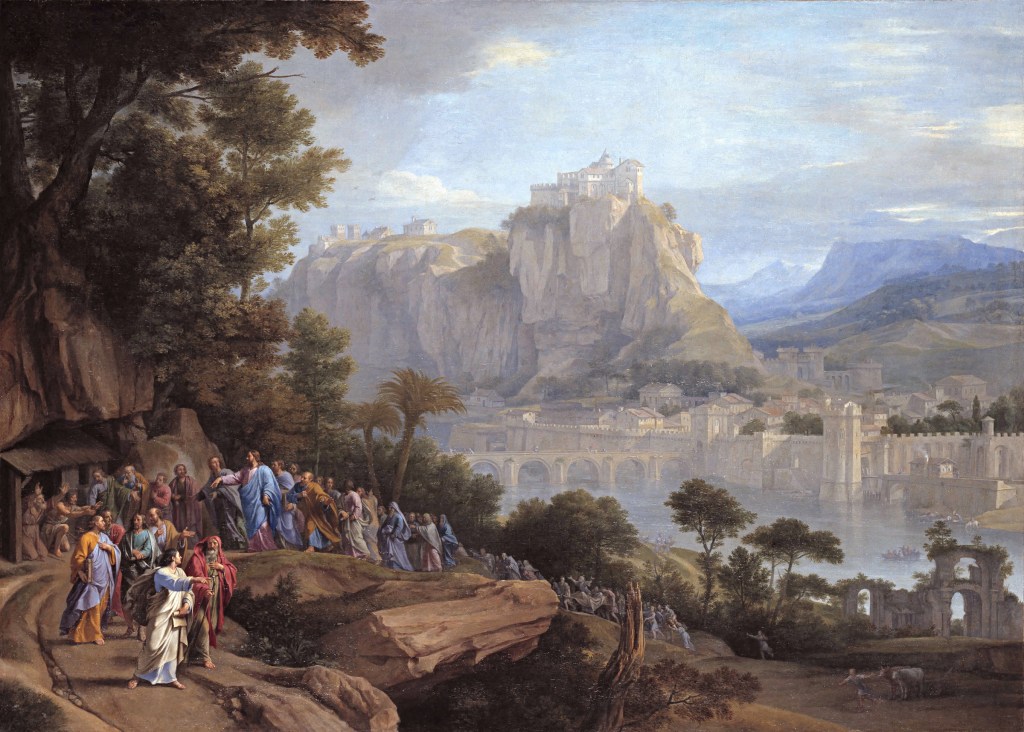
In Matthew 20:29–34, Jesus heals two blind men on the road to Jerusalem. As Jesus passes by them, they cry out for healing. The crowds get annoyed and tell the blind men to hush. They cry out all the more. They call Jesus the Son of David. They passionately acknowledge that He is the Messiah. They trust in His power to heal. In Jerusalem, Jesus will be confronted by religious elites who are unable to recognize Him for who He is. Here on the road to Jerusalem, the blind can see what those religious elites are blinded to. What an irony! Before Jesus heals them, he asks, “What do you want me to do for you?” The blind men answer, “We want our sight.” Jesus heals them, and the blind men follow Him.
The same story is told in Mark 10:46-52. Mark’s version of the story is generally more detailed, which is unusual given that Mark is known for being short and to the point. For example, Mark tells us that one of the blind men was named Bartimaeus; Matthew doesn’t include any names. Mark tells us that Bartimaeus was a beggar, and that he jumped out of his seat and threw off his cloak when he was healed; Matthew leaves these details out. One interesting detail that Matthew does include, however, is that two men were healed. Mark only mentions one, Bartimaeus. Why might Matthew add a second beneficiary? He does this a lot, actually. Several miracle stories in Matthew record two beneficiaries where other gospels record only one. It’s not always clear why he does this, but in chapter 20, I think the immediate context points to at least one plausible explanation.[1]
Just a few verses earlier, in vv. 20-28, the apostles James and John ask for seats of honor in Jesus’s kingdom.[2] The other ten apostles get frustrated with James and John’s request (v. 24), in much the same way that the crowd gets frustrated with the two blind men’s request (v. 31). But there is a profound difference between the request of the two brothers and the request of the two blind men. The two brothers were asking for power and status, while the two blind men were asking merely to see. Rodney Reeves writes in his commentary, ” Those who think they see want power; those who know they are blind need Jesus.”[3]
I think Matthew intends for the two blind men in vv. 29-34 to be seen as anti-types of the two apostles (James and John) in vv. 20-28. When Jesus asks the blind what they want, they ask for only what they need: sight. They don’t ask for things like power or status. Jesus responds to their humble and sincere request with compassion. The two men respond by following him. The word for ‘follow’ here is akoloutheō, which is often used in the NT to portray discipleship. While it’s possible that they only followed Jesus in a physical sense, the context suggests that Matthew is wanting to portray these two men not merely as beneficiaries of a miracle, but as model disciples—in contradistinction to James and John, who had been following Jesus all this time but could not yet understand the upside-down nature of His kingdom.
Taken in tandem, these two stories pose a profound question to disciples today: What do we (really) want from Jesus?
[1] For a list of possible explanations, see R. T. France, The Gospel of Matthew, New International Commentary on the New Testament (Grand Rapids: Eerdmans, 2007), 339.
[2] Rodney Reeves was the commentator who first gave me the idea to read vv. 29–34 in light of vv. 20–28. I am indebted to him for much of the following insight. See Rodney Reeves, Matthew, Story of God Bible Commentary (Grand Rapids: Zondervan Academic, 2017), 394–403.
[3] Ibid., 399.
 Jared Dale Greer
Leave a comment