In my previous post, I suggested that paedobaptists (those who baptize infants) are correct to recognize baptism as a gracious gift, a work of God. I would like to begin this post with another affirmation: paedobaptists are correct to emphasize baptism as a means of entrance into a covenant community. It is true that we are all baptized “into one body” (and that of Christ, cf. 1 Cor 12:12–13). We are baptized, if you will, into ‘one holy, catholic, and apostolic church.’ Even so, it would be a mistake to suggest a precise, one-to-one correspondence between circumcision and baptism. Perhaps the most obvious indicator that circumcision and baptism are not serving precisely the same function is the fact that, in Scripture, circumcised Jews who accepted Jesus as Messiah also needed to receive Christian baptism (e.g., Paul, the crowd at Pentecost, and Jesus himself). If circumcision was sufficient to bring these Jews into covenant community, why the need for baptism? What does baptism accomplish that circumcision does not? What distinguishes these two covenantal signs?
Baptism is about entering a new covenant community, yes—and this community is indeed an extension of (and not a replacement for) Israel. But the NT conceptualizes this particularly Messianic community as being constituted by believing, allegiant, forgiven, regenerate disciples of Jesus the Messiah. As Steve Wellum has noted, Israel under the old covenant is “a ‘mixed’ entity, comprising believers and unbelievers—Elijahs and Ahabs simultaneously—even though all males within the covenant nation, regardless of whether they were spiritually regenerate, were marked by the covenant sign of circumcision.”[1] By contrast, the Messianic community, the church, is definitionally made up of committed, regenerate disciples. In the new covenant community, all members know the Lord (Heb 8:11–12, cf. Jer 31:34) and all are filled with the Holy Spirit (Acts 2, cf. Joel 2). The fact that all members are faithful, regenerate disciples is a feature—not a bug—of the Messianic community.
All of this makes sense of why, in the NT, baptism is inextricably bound up with faith, confession, and repentance. Baptism is first introduced in the NT through John, who preaches a baptism “of repentance for the forgiveness of sins” (Mark 1:4; Luke 3:3). Ritual washings happened daily during the time of John; but John’s baptism was unique on several fronts, not least of which was his explicit demand for repentance (Luke 3:7–14). Those who accepted John’s baptism penitently confessed their sins (Matt 3:6; Mark 1:5). While the baptism of John is distinguished from Christian baptism (Acts 19:1–7), the important distinction is not that repentance is no longer necessary (cf. Acts 2:37–38). Rather, Christian baptism is primarily distinguished by 1) one’s adoption into the kingdom as a child of God, and 2) one’s reception of the Holy Spirit. We would therefore be justified in calling Jesus’s own baptism the first ‘Christian’ baptism.
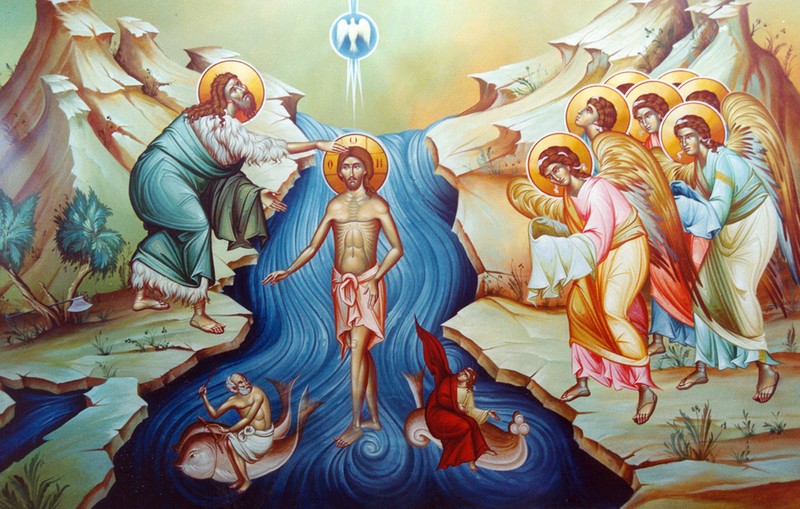
Jesus certainly has no sin of which to repent; but John Mark Hicks rightly notes that when Jesus is baptized, he “repents” insofar as he “changes his life, turns toward his calling, and begins to pursue it.”[2] This is a conscious, embodied act of allegiance. His baptism is an “act of discipleship where he submits to the Father’s kingdom agenda.”[3] More, Jesus receives the Holy Spirit at his baptism; we’re told that the heavens open up and the Holy Spirit descends on him “like a dove” (Luke 3:21–22). In this climactic moment, Jesus is explicitly recognized and affirmed as God’s beloved Son (Luke 3:22). This is paradigmatic of our own baptism. When we follow Jesus into the waters of baptism as an embodied act of discipleship, we commit ourselves to ministry in God’s kingdom; God gifts us with the Holy Spirit; and we are recognized and affirmed as God’s beloved children.
When Peter preaches Christian baptism at Pentecost, the repentance and forgiveness associated with John’s baptism do not go away; but faith in Jesus as the Christ and reception of the Holy Spirit are now incorporated (Acts 2:37-39). Again: faith, confession, repentance, and baptism are interlaced in the NT. Matthew Bates is correct to suggest that NT authors “take pains to highlight the retention of agency” in baptismal subjects.[4] Even in the household baptism narratives often cited by paedobaptists, Luke goes out of his way to emphasize the faith and agency of those baptized in the households—often highlighting that they were not merely baptized, but that they “heard,” “believed,” and/or “rejoiced” (e.g., Acts 16:34; 18:8–9). The repeated correlation in Luke’s writings between baptism and ‘calling on the name of the Lord’ (e.g., Acts 22:16) indicates that some kind of personal prayer, appeal, and/or (most likely) confession typically accompanied NT baptism. And ironically, even Colossians 2:12, a common proof-text for infant baptism (more on that in my next post), poses a challenge to paedobaptism by indicating that baptism is made effectual “through faith in the working of God.” John Mark Hicks and Greg Taylor reasonably infer, “If faith renders baptism effectual, then baptism without faith is ineffectual.”[5]
The bottom line is this: we have no clear examples in the NT or in early Christianity of baptism happening apart from faith and repentance. Some paedobaptists have argued for the possibility of ‘infant faith’—drawing from the examples of John the Baptist (Luke 1:44) and David (Psalm 22:9). Some have also argued that the parents of an infant can offer vicarious faith on the infant’s behalf (drawing primarily from the healing narrative in Matt 15:22–28). I’m not opposed to infant belief; but even if such a notion were to be conceded, I’m not confident in its normativity for conversion. As we’ve already observed, there is little in the NT that points toward its normativity. It seems to me that paedobaptists make too much of too little in this regard. Moreover, it’s difficult to discern how an infant could repent (or how a parent could vicariously repent on his/her behalf). How can paedobaptists account for the consistent NT portrayal of baptism as a personal act of discipleship—as a conscious, embodied act of allegiance?
The historical record of the early church is often cited in support of paedobaptism; and paedobaptism did receive widespread support from the fifth century onward. But from my vantage point, the earliest data we have actually favors credobaptism. At the very least, the data is ambiguous and indeterminate. I contend that the first two centuries strongly suggest the normativity of credobaptism. In the third and fourth centuries, we slowly begin to see a muddled diversity of views; and by the fifth century, an age of widespread acceptance of infant baptism is ushered in by Augustine.
The earliest Christian text we have outside of the NT is the Didache, which was likely written around the turn of the second century. The Didache strongly encourages full-body immersion in the name of the Father, Son, and Holy Spirit—though pouring water over the head was permitted if there was no running water or baptismal font available for immersion (7:1–3). The text also presupposes that a baptismal candidate was able to receive teaching (7:1), and that he/she was able to penitently fast for one or two days before baptism (7:4). This same sort of correlation between repentance and baptism is indicated by several other writings from the Apostolic Fathers (e.g., Shepherd of Hermas, Epistle of Barnabas, and 1 & 2 Clement), as well as by Justin Martyr in the mid-second century. In his description of the conversion process, Justin says that prior to receiving baptism, “all those who are persuaded and believe that these things which we teach and say are true, and who give an undertaking that they are able so to live, are to pray and to ask with fasting for forgiveness from God for their past sins, and we pray and fast with them.”[6]
In an essay about the nature of baptism in the Patristic period, historian Everett Ferguson lays out several other brief lines of evidence that gesture toward the normativity of credobaptism during the early centuries. The earliest baptismal liturgies we have presuppose the agency of those receiving baptism, as well as their ability to speak; the earliest baptistries that archaeologists have uncovered are sized for adults, not infants; and the first unambiguous mention of infant baptism is made by Tertullian, rather disapprovingly, sometime around the turn of the third century.[7] In the fourth century, explicit support for infant baptism increases; but, as Ferguson points out, “It is striking that nearly all the prominent church leaders of the fourth century, including those from strong church families, the date of whose baptism we know, were baptized as adults.”[8] The most obvious examples of this phenomenon would be the Cappadocian fathers. Basil, Gregory of Nyssa, and Gregory of Nazianzus do not oppose infant baptism; but interestingly, they themselves are not baptized as infants, despite coming from devout Christian families.
In another important essay, Ferguson makes a compelling case from archaeological evidence that the practice of infant baptism had its origins in the scrupulosity of families with terminally ill children. Some of the earliest evidence we have of child baptisms are inscriptions found on the tombs of deceased children. These tombs date back to the third century; and according to their inscriptions, the deceased children were baptized not in early infancy but mere days (or in some cases, hours) before their death. Ferguson concludes that in these instances, scrupulous parents—out of a firm conviction that baptism was essential for salvation—anticipated the child’s death and baptized the child out of desperation, hoping the child would be saved.[9] One inscription makes this concern explicit: “Florentius made this monument for his well-deserving son Appronianus, who lived one year, nine months, and five days. Since he was dearly loved by his grandmother, and she saw that he was going to die, she asked from the church that he might depart from the world a believer” (ILCV 1343). In sum, infant baptism appears to emerge as an emergency protocol in the early church. It does not seem to be the norm.
The practice of infant baptism did become widespread starting with Augustine in the fifth century. Augustine argued for infant baptism in the context of his controversy with Pelagius; and his primary explanation of its function was forgiveness from original sin. Nevertheless, while infant baptism had been practiced before the time of Augustine, the concern for forgiveness from original sin was a mostly novel rationale. It does not appear to be the rationale of the fourth-century fathers in the East who also affirmed infant baptism (e.g., the Cappadocian fathers and John Chrysostom). In his third-century homilies, Origen does anticipate something like Augustine’s rationale; but the idea does not seem to develop much further and/or catch steam until we reach Augustine in the fifth century.
Much more can be said; but the above is sufficient to make my modest point that the patristic evidence is, at a minimum, ambiguous. Credobaptism appears normative for at least the first two centuries. In the third and fourth centuries, infant baptism slowly comes into play and muddies the waters; but even then, adult baptism seems to be widely practiced. By the fifth century, infant baptism is more or less customary; but Augustine’s rationale for the practice is a departure from that of his contemporaries.[10] I sympathize with the theological concerns of paedobaptists—and I will briefly consider the state of children in my next post. But in my current reading of the data, infant baptism appears to be alien to the NT text and an accretion in the early church. In my final post, I will consider some texts that problematize my position (Col 2:11–12; Acts 2:39; and Mark 10:13–16//Matt 19:13–15//Luke 18:15–17); clarify my view of children and original sin; and summarize my provisional conclusions on this issue.
[1] Stephen J. Wellum, “Baptism and the Relationship between the Covenants,” in Believer’s Baptism: Sign of the New Covenant in Christ, ed. Thomas R. Schreiner and Shawn Wright (Nashville: B&H Academic, 2006), 134.
[2] John Mark Hicks, Transforming Encounters: Baptism, Assembly, and the Lord’s Supper, Doctrina Series (Abilene, TX: Abilene Christian University Press, 2020), 73.
[3] Ibid.
[4] Matthew W. Bates, Beyond the Salvation Wars: A New Hope for the Church, (Grand Rapids: Baker Academic, 2023), 120.
[5] John Mark Hicks and Greg Taylor, Down in the River to Pray, rev. ed., Kindle ed. (Abilene, TX: Leafwood Publishers, 2021), loc. 2071.
[6] Justin Martyr, First Apology 61.2, in Justin, Philosopher and Martyr: Apologies, ed. and trans. Denis Minns and Paul Parvis, Oxford Early Christian Texts (New York: Oxford University Press, 2009), 237, 239. Emphasis mine.
[7] Everett Ferguson, “Baptism in the Patristic Period,” in The Early Church and Today, vol. 1, Ministry, Initiation, and Worship, Kindle ed. (Abilene, TX: Abilene Christian University Press, 2012), locs. 2988–3044.
[8] Ibid., loc. 3016.
[9] Everett Ferguson, “Inscriptions and the Origin of Infant Baptism,” Journal of Theological Studies 30 (1979): 37–46.
[10] See Everett Ferguson, Baptism in the Early Church: History, Theology, and Liturgy in the First Five Centuries (Grand Rapids: Eerdmans, 2009), for a comprehensive treatment of credobaptism and paedobaptism in the early church.
 Jared Dale Greer
Leave a comment